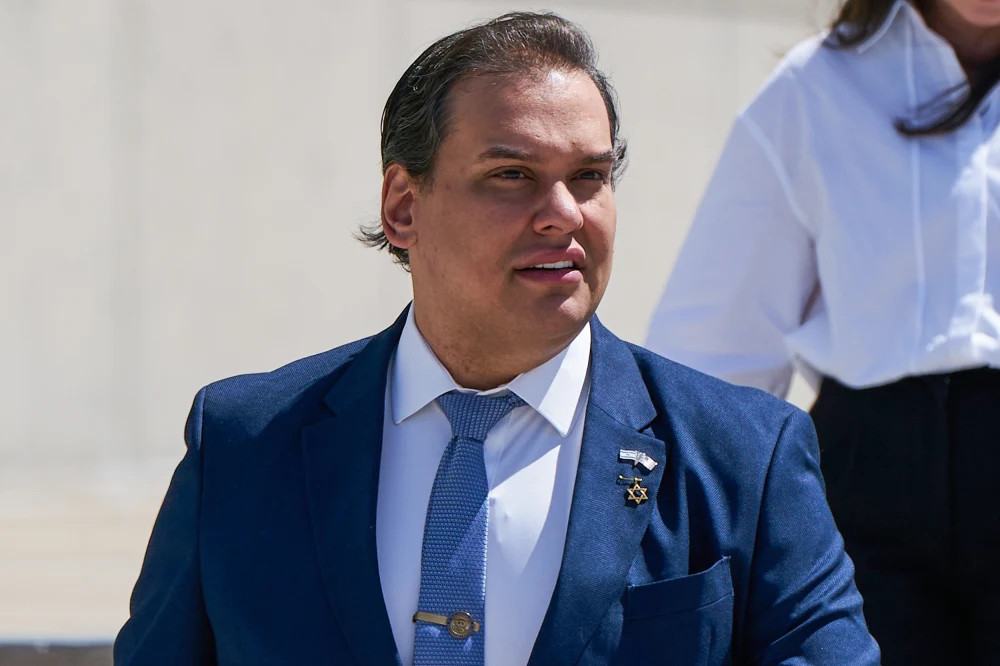
Former U.S. Rep. George Santos has agreed to pay $35,000 to settle a federal investigation into his activity on the prediction market platform Kalshi, resolving allegations tied to trades he made before President Donald Trump’s State of the Union address.
The settlement, announced Friday, brings an end to a probe by the Commodity Futures Trading Commission (CFTC) into what regulators described as suspicious trading activity. Santos, however, maintains that the agreement should not be viewed as an admission of guilt and says he chose to settle simply to avoid a lengthy legal battle.
Santos Denies Any Wrongdoing
In a statement shared on social media platform X, Santos said the settlement allows him to move forward without the expense and uncertainty of continued litigation.
His attorney, Joseph Murray, emphasized that the agreement was a practical business decision rather than an acknowledgment of any legal violations.
“He chose a prompt, practical resolution, rather than protracted, costly litigation, and that choice should not be mistaken for admission of any wrongdoing, because it is not one,” Murray said.
Under the terms of the settlement, Santos agreed to pay the financial penalty without admitting or denying the allegations raised by federal regulators.
Investigation Centered on Kalshi Trades
The federal investigation focused on Santos’ trading activity on Kalshi, a federally regulated prediction market that allows users to buy and sell contracts based on the outcome of future events, including political developments, economic indicators, and other public events.
According to investigators, Santos placed trades that effectively bet against his own stated plans to attend President Donald Trump’s State of the Union address. Regulators questioned whether those trades may have relied on information that was not publicly available at the time.
The CFTC reviewed whether Santos’ actions violated federal rules governing prediction markets, though the settlement avoids a formal court ruling on the allegations.
What Is Kalshi?
Kalshi operates as a regulated prediction marketplace where participants can trade contracts tied to real-world events. Rather than investing in traditional stocks or commodities, users speculate on whether specific events will occur.
Because prices on the platform often reflect public expectations about future events, regulators closely monitor trading activity for potential market manipulation or the misuse of nonpublic information.
The case involving Santos has drawn attention to the growing popularity of prediction markets and the regulatory challenges that accompany them.
Another Legal Chapter for Santos
The Kalshi settlement adds to a series of legal and ethical controversies that have surrounded Santos since he entered Congress.
The former New York Republican became one of the most controversial figures in recent political history after revelations that he had fabricated significant portions of his personal and professional background during his congressional campaign. Those disclosures led to multiple investigations, bipartisan criticism, and ultimately his expulsion from the House of Representatives.
Santos has also faced separate criminal charges related to campaign finance and fraud allegations, many of which remain separate from the CFTC matter.
Settlement Brings Probe to a Close
While the $35,000 settlement closes the CFTC’s investigation into Santos’ Kalshi trading activity, it does not resolve his broader legal issues.
Federal regulators have not announced any additional penalties related to the prediction market investigation, and the agreement concludes the case without Santos admitting liability.
For Santos, the settlement represents an effort to move beyond yet another legal dispute. For regulators, the case underscores increasing scrutiny of trading activity on prediction market platforms, particularly when participants may possess information that could influence market outcomes.