BLYTHEWOOD — A proposed Freedom of Information policy for the Town of Blythewood is raising questions over whether several of its provisions align with South Carolina’s Freedom of Information Act.
The proposal comes amid an ongoing dispute over access to public records involving a $20,000 hospitality tax payment connected to Blythewood’s planned 2025 Juneteenth celebration.
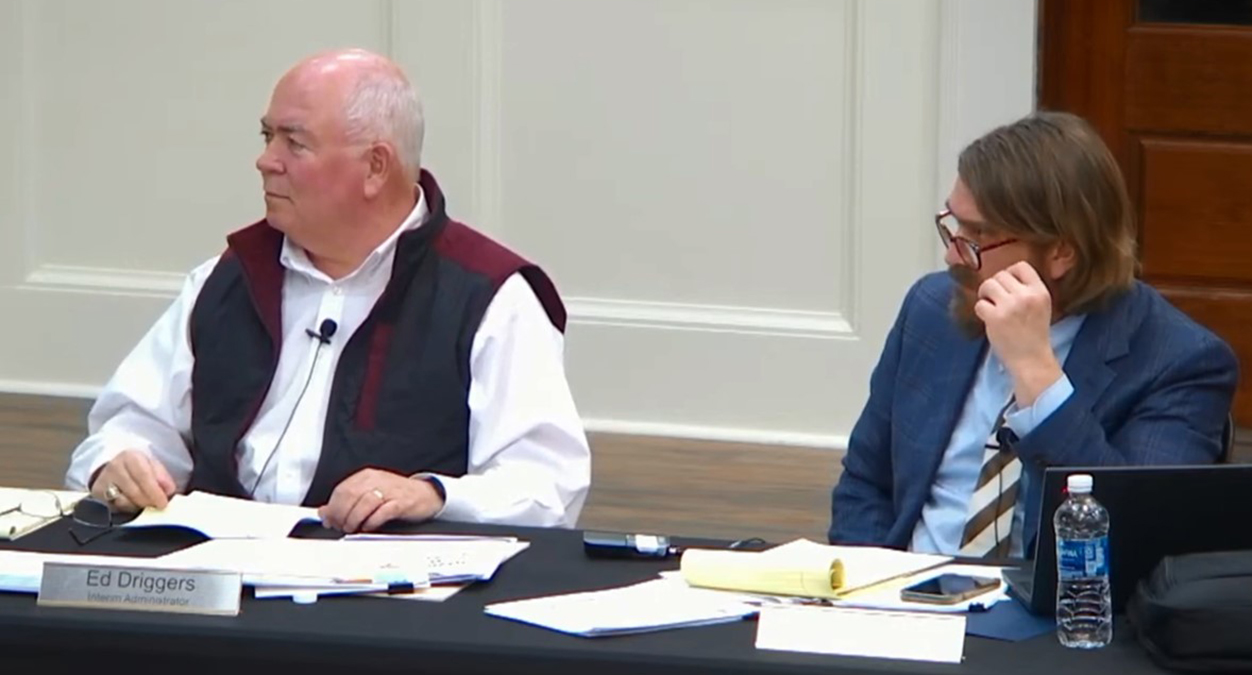
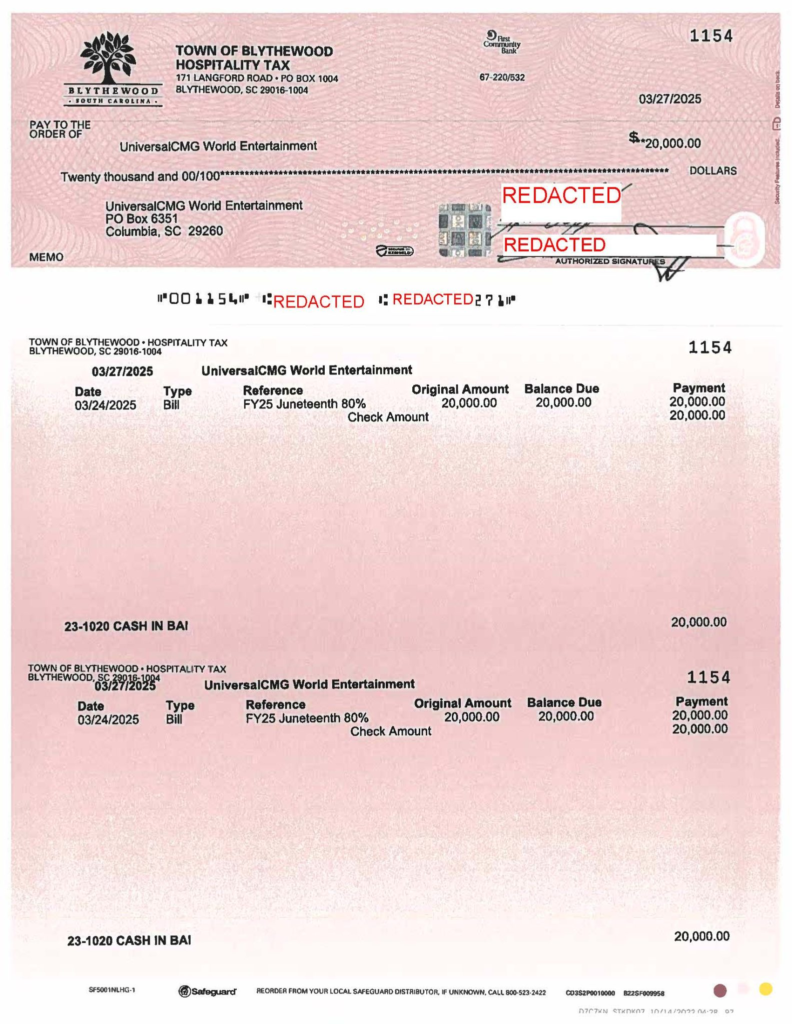
Public records obtained by The Voice show that the $20,000 check was signed by both Mayor Sloan Griffin and former Interim Town Administrator Ed Driggers. The signatures appear to conflict with a statement Driggers later made to Town Council that he “was not involved in this at all.”
When The Voice initially filed a Freedom of Information request seeking records related to the payment, the Town assessed a $500 fee for producing the requested documents. Town Attorney Pete Balthazor has since proposed a policy that would establish standards for handling FOI requests, including provisions related to fees, attorney involvement, outside vendors and fee waivers.
A review by The Voice identified several areas where the proposed policy appears to differ from language in South Carolina’s Freedom of Information Act.
State Law Emphasizes Public Access
South Carolina’s Freedom of Information Act states that public business should be conducted openly so citizens can learn about the actions of public officials with minimal cost or delay.
Concerns about the proposed policy have already been raised publicly.
During a January 2026 council meeting, Councilman Donald Brock said that high fees and additional inconveniences associated with obtaining public records could have a chilling effect and discourage members of the public from filing FOI requests.
Proposed Attorney and Vendor Fees
One significant issue involves the costs that can be passed on to people requesting public records.
Under South Carolina law, fees associated with searching for, retrieving and redacting records may not exceed the prorated hourly salary of the lowest-paid employee qualified to perform the work. The law also limits charges associated with determining whether records are subject to disclosure.
Balthazor’s proposal would allow certain costs to include work performed by the town attorney at the attorney’s standard hourly rate, as well as charges from outside vendors used to search for or retrieve records.
The proposed policy also directs the Town’s FOIA officer, the town clerk, to consult the town attorney regarding non-routine requests and questions involving exemptions from disclosure. The proposal does not clearly define what would qualify as a “non-routine” request.
Balthazor previously defended the approach during a council meeting.
“I think what the law says is that we are entitled to recoup actual expenses to retrieve data,” he told council.
When Councilwoman Trisha Hovis questioned whether attorney review costs should be charged to requesters, Balthazor said the policy would allow the town manager to determine when a request requires more extensive legal review.
Under the proposed arrangement, those costs could ultimately be included in the amount charged for fulfilling the request.
Questions Over Fee Waivers
Fee waivers are another point of disagreement.
South Carolina’s FOI law allows public agencies to reduce or waive fees when releasing the requested information is determined to be primarily in the public interest.
Balthazor’s proposed policy would eliminate fee waivers.
During the June 22 council meeting, Balthazor questioned whether the Town had discretion to waive such fees in the first place.
“I don’t know that there was any discretion there to begin with,” he told council, adding that the proposed policy was intended to prevent officials from selectively deciding who receives a waiver.
No Specific Fee Schedule
Another concern identified by The Voice is the absence of a specific published fee schedule in the proposed policy.
Without clearly established rates, requests involving attorneys or outside vendors could potentially result in substantial costs, even when relatively few records are ultimately produced.
This issue is particularly relevant because of The Voice’s previous attempt to obtain documents concerning the Town’s $20,000 hospitality tax payment.
Questions Surrounding the $20,000 Juneteenth Payment
The dispute over public records stems from a $20,000 payment issued in March 2025 to Universal CMG World Entertainment, a for-profit company owned by Edward Straiter.
Mayor Sloan Griffin has described Straiter as a close friend and mentor.
During a November 2025 budget discussion, Town Marketing and Events Manager Jordan Langland informed council that $20,000 allocated for the Town’s Juneteenth celebration could not be accounted for.
Records later obtained by The Voice from council members indicated that Griffin instructed Langland on March 24, 2025, to prepare a $20,000 check from the Town’s hospitality tax fund payable to Universal CMG World Entertainment.
Council members said during the November meeting that they had not been aware of the payment, which had been outstanding for approximately nine months.
The Voice previously reported that the payment was issued without a hospitality tax application and that the recipient was a for-profit business rather than a nonprofit organization. The newspaper reported that this raised questions about compliance with requirements governing the use of hospitality tax funds.
Town officials later reported that the Juneteenth event was ultimately held in Chester, South Carolina, without the council’s prior knowledge.
Newspaper Charged $500 for Records
On Dec. 19, 2025, The Voice submitted an FOI request seeking documents related to the $20,000 payment.
The Town initially charged the newspaper $500 to fulfill the request.
After The Voice said it could not pay the fee, Town Council unanimously directed officials to provide the records without charge.
The documents ultimately provided included several emails between Griffin and Straiter, but according to The Voice, they did not include substantial documentation explaining the $20,000 payment.
Check Raises Questions About Earlier Statement
During a March 2026 council meeting, council members questioned Griffin and Driggers about the payment and the check prepared by Langland on March 24, 2025.
Driggers told council:
“May I insert that on March 24, 2025, I was not here. I was not involved in this at all.”
Following additional records requests, Balthazor provided The Voice with a copy of the cashed $20,000 check, but the signatures had been redacted.
The Voice subsequently obtained an unredacted copy from another source. That copy shows signatures attributed to both Griffin and Driggers on the check, dated March 27, 2025.
The document therefore raises questions about Driggers’ statement concerning his involvement with the payment.
Town Did Not Seek Recovery of Funds
Emails obtained by The Voice through means other than an FOI request also indicate that, during December 2025, a council member repeatedly asked Driggers and Balthazor to investigate whether the Town could recover the $20,000 payment from Straiter.
In a Jan. 7, 2026 email to council members marked “privileged and confidential,” Balthazor advised against attempting to recover the funds.
“The Town’s violation of its own policies does not provide a basis for the return of any income from Universal,” Balthazor wrote. “I also do not believe that the Town can claw back the funds.”
The Town has not subsequently pursued legal action to recover the $20,000.
Council Scheduled to Consider Policy
Balthazor initially introduced the proposed FOI policy as an ordinance during the May 26, 2026 council meeting and indicated that it could later be amended by resolution.
At the June 22 meeting, council members noted that an ordinance generally must be amended through another ordinance requiring two readings. They suggested presenting the FOI policy as a resolution instead, which would require only one reading.
Council is scheduled to consider the resolution at its Monday, July 27 meeting at 6 p.m. at Doko Manor. Members of the public will have an opportunity to speak before council votes.
The dispute leaves two issues before the Town: whether the proposed FOI policy complies with South Carolina law and whether the public has received a complete accounting of the $20,000 hospitality tax payment.
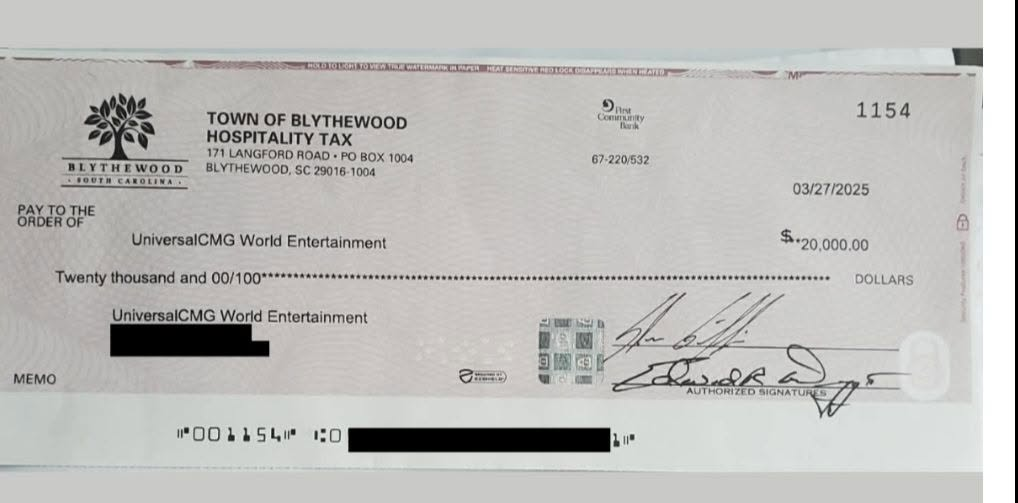
The redacted copy of the $20,000 check was provided to The Voice by Town Attorney Pete Balthazor. The Voice subsequently obtained an unredacted copy from another source showing signatures attributed to Mayor Sloan Griffin and then-Interim Town Administrator Ed Driggers, dated March 27, 2025.
Sourced: BlythewoodOnline