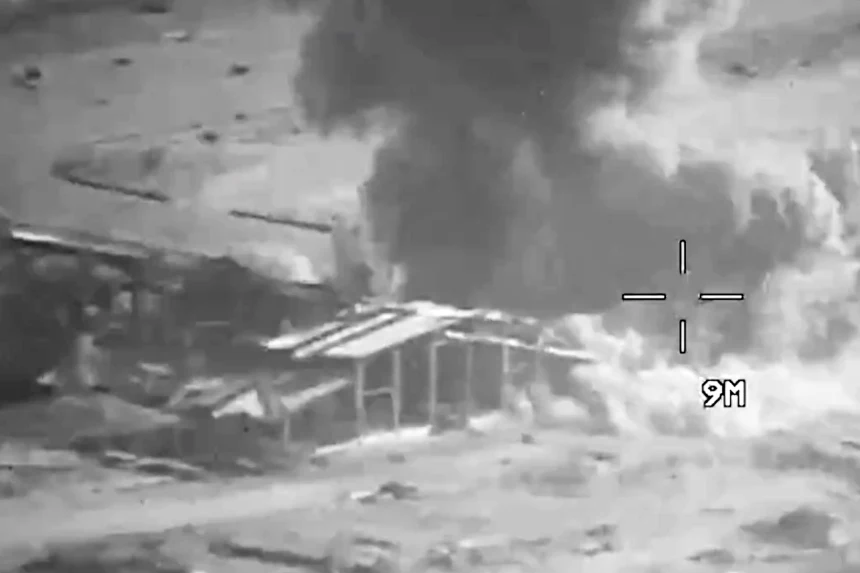
JERUSALEM — The United States carried out a new round of military strikes against targets in Iran overnight, intensifying an already volatile conflict as President Donald Trump warned that Washington could launch a “massive attack” against the Islamic Republic if tensions continue to escalate.
The latest military action marks the 13th consecutive night of U.S. strikes, underscoring the rapidly deteriorating security situation in the Middle East. The developments come after Iran expanded its campaign of military and economic pressure, opening what officials describe as a second front that has heightened concerns over regional stability and global energy supplies.
Trump signals possibility of larger military action
Speaking to Axios on Thursday, Trump indicated that his administration is considering a significantly broader military response.
The president said he was weighing the option of a “massive attack” on Iran—one that would be “bigger than ever before”—if Tehran continues actions that threaten U.S. interests and regional security.
While the White House has not announced any final decision, Trump’s remarks have fueled speculation that the conflict could escalate beyond the current exchange of strikes, raising fears of a broader regional confrontation involving additional countries and armed groups.
Hours after the president’s warning, U.S. forces launched another wave of strikes against Iranian targets, continuing a campaign that has intensified over nearly two weeks.
Iran expands pressure campaign
The latest escalation follows Iran’s move to widen its military and economic pressure strategy, a development that has heightened concerns among global leaders.
Although officials have not disclosed the full scope of Iran’s latest actions, analysts say Tehran’s strategy appears aimed at increasing pressure on the United States and its allies while disrupting regional security and international trade routes.
The growing conflict has also rattled global financial markets.
Oil prices briefly climbed above $100 per barrel following Trump’s comments and the overnight strikes, reflecting investor concerns that a prolonged conflict could disrupt energy exports from the Middle East, a region responsible for a significant share of the world’s oil supply.
Diplomacy appears to be stalling
Despite ongoing international efforts to reduce tensions, diplomatic progress remains limited.
According to NBC News, there are increasing signs that several U.S. allies in the Middle East are becoming frustrated by the daily escalation and the lack of meaningful negotiations.
“It’s only getting crazier,” one senior Arab official directly involved in diplomatic efforts told NBC News, expressing concern that repeated military exchanges are pushing the region closer to a wider war.
Regional governments have reportedly continued behind-the-scenes discussions in an effort to prevent further escalation, but no significant breakthrough has been announced.
Concerns grow over regional stability
Security experts warn that continued military operations increase the risk of miscalculation, particularly if additional countries or Iran-backed armed groups become involved in the conflict.
The Middle East remains home to numerous U.S. military bases, strategic shipping routes, and critical energy infrastructure, making any expansion of hostilities a matter of international concern.
Governments around the world are closely monitoring the situation, with many urging restraint and renewed diplomatic engagement to avoid a broader conflict that could have significant humanitarian, economic, and geopolitical consequences.
Global markets on edge
The continuing hostilities have added uncertainty to global markets, particularly in the energy sector. Traders are closely watching developments for any signs that oil production or shipping through key waterways could be disrupted.
As military operations continue and diplomatic efforts struggle to gain momentum, international leaders face growing pressure to find a path toward de-escalation before the crisis evolves into a larger regional conflict.
Editor’s note: This article is based on initial reports. Details surrounding the military operations and diplomatic developments may continue to evolve as additional information becomes available.